Control NEXT is a platform for sharing knowledge and experiences on Real-time Control (RTC) in water systems. The water systems where the controllers from Control NEXT can be applied, range from surface water systems to sewer systems to hydro power systems. Control NEXT offers a platform for exchanging knowledge on the controllers and their application, but also invites users to contribute to developing new controllers.
New?
If you are new to Control NEXT, please visit
What is it
for general information about Control NEXT and how it could benefit you.
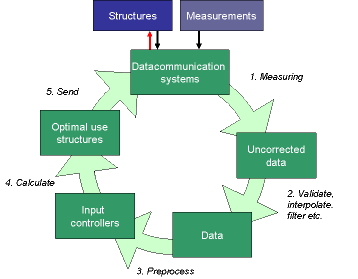
The cycle in which real-time controllers are used
Introduction
Because of climate change, soil subsidence and sea level rise, and because of population growth and increasing prosperity, the pressure on our water system is increasing. We want our water to be clean, to have sufficient water available and we certaintly want no floodings. We also want to minimize sewer overflows and limit the required capacity for our wastewater treatment plants. Finally, we want to reduce our energy costs and if possible, even generate energy from our (waste) water flows.
We often choose to raise dikes, build new pumps and dig new canals. These actions are often very expensive. Another method is to optimize the existing (waste) water system by using real-time control. This allows reduction of pollution of surface water, reduction of required capacity for wastewater treatment plants, prevention of floodings and better respons to failures in the controlled system.
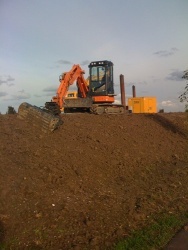
In many cases RTC can reduce the need to heighten dikes
Real-time control is not a new technology, but in the (waste) water management is still limited aplied. To encourage the development and implementation of real-time control and to share experiences a platform was developed: Control NEXT. By sharing knowledge and experience we try to optimize the knowledge and experience on real-time control. So Control NEXT aims to share knowledge and experience of RTC controls and make it available via open standards to users.
Why Control NEXT?
Real-time control is a technique for processing real-time information quickly to control structures such as intakes, pumping stations, dams and pumps. By applying this technique, the (waste) water system can be optimized, thus reducing costs while controlling the water system more efficiently.
The benefits of real-time control are:
- Cost savings through less investment in infrastructure and lower energy consumption
- A greater environmental benefit, for example by reducing sewer overflows organized and sparing fragile waters.
- Hanlding disruptions in the water system
What is Control NEXT?
NEXT Control is an open platform where knowledge on the field of real-time control, from simple to very complex, can be shared and applied. These include the controllers as an algoritm themselves, as well as end products and its application in operational systems. All components with the Control NEXT stamp are open-source (LGPL license) and are available through the WIKI. This ensures that all developments reinforce each other.
What can Control NEXT?
Control NEXT is a modular control system specifically developed for the water sector to make it easier to apply real-time control. Control NEXT is no substitute for telemetry systems, but is connected to the existing telemetry systems. Control NEXT can also be connected to systems like weather (forecast) systems. This way the controllers form smart links between diferent systems.
The controllers from Control NEXT are free for use. For coding the controllers standard scripting languages are used. This provides a flexible way to add new controllers. Within the Control NEXT platform it is possible to have more than 1000 controllers run independently to control the water system. It makes no difference whether the system controls of open water systems, sewer systems or water treatment systems.

The modules of Control NEXT can be considered as building blocks
Simple and complex controls
Special to Control NEXT is that besides simple (if-then-else, or PID) controllers, advanced state-of-the-art controllers are available. These controllers are suitable for large and complex applications such as controlling an entire treatment group, complex atrial polder canals and river systems or networks with hundreds of input and output variables that drive numerous water structures.
Control NEXT community
Control NEXT was established by a consortium in which science, knowledge institutions and consultants meet: TU Delft, Nelen & Schuurmans and Deltares. Control NEXT has an open structure in which open third-party software can easily be included, for example the NMPC control of DotxControl.
Control NEXT is fully compatible with Delft-FEWS and Lizard and is available without licensing fees.
Aanleiding
Door klimaatsverandering, bodemdaling en zeespiegelstijging, maar ook door bevolkingsgroei en toenemende welvaart, wordt de druk op ons watersysteem steeds groter. We willen dat ons water schoon is, dat er voldoende water beschikbaar is en dat we geen wateroverlast hebben. Verder willen we de riooloverstortingen minimaliseren en de capaciteit van onze zuiveringen beperken. Ten slotte willen we onze energiekosten beperken en als het mogelijk is zelfs energie opwekken uit ons (afval)water.
Vaak kiezen we ervoor om dijken te verhogen, gemalen bij te bouwen, gebieden af te koppelen, randvoorzieningen te bouwen en nieuwe leidingen of kanalen te graven. Deze ingrepen zijn vaak erg kostbaar. Een andere werkwijze is om eerst het bestaande (afval)watersysteem te optimaliseren, door gebruik te maken van sturing oftewel real-time control. Hiermee kan de vervuiling van het oppervlaktewater worden verminderd, de capaciteit van de zuiveringen worden gereduceerd, hoog water vaker worden voorkomen en kan beter worden gereageerd op storingen.
Real-time Control is niet nieuw, maar wordt in het (afval)waterbeheer nog beperkt toegepast. Om de ontwikkeling en toepassing ervan te stimuleren en de ervaringen te delen is hiervoor een platform ontwikkeld: Control NEXT. Hiermee wordt voorkomen dat het wiel steeds opnieuw wordt uitgevonden. Control NEXT heeft tot doel om kennis over en het gebruik van RTC regelaars te delen en via open standaarden beschikbaar te maken voor gebruikers.
Waarom Control NEXT?
Real-time control is een techniek om actuele meetinformatie snel (in real-time) te verwerken om daarmee bijvoorbeeld inlaten, gemalen, pompen en stuwen aan te sturen. Door deze techniek toe te passen kan het (afval)watersysteem worden geoptimaliseerd, waardoor met minder kosten meer rendement uit het (afval)watersysteem wordt gehaald.
De voordelen van real-time control zijn:
- kostenbesparing door minder investeringen in infrastructuur en een lager energieverbruik
- een hoger milieurendement door bijvoorbeeld een reductie van riooloverstortingen en het ontzien van kwetsbare wateren.
- storingen in systeem opvangen
Wat is Control NEXT?
Control NEXT is een open platform waar kennis kan worden gedeeld en toegepast op het gebied van real-time control, van eenvoudig tot zeer complex. Het gaat daarbij op de regelingen zelf, als algoritme maar ook als uiteindelijk product en de toepassing daarvan in operationele systemen. Alle componenten met het Control NEXT stempel zijn open-source (LGPL licentie) en worden via de WIKI beschikbaar gesteld. Op deze manier kunnen we er gezamenlijk voor zorgen dat alle ontwikkelingen elkaar versterken.
Ook kunt u meewerken aan en discussiëren over nieuwe regelingen.
Wat kan Control NEXT?
Control NEXT is een modulair systeem dat specifiek voor de watersector is ontwikkeld om toepassing van real-time control in de praktijk eenvoudiger te maken. Control NEXT is geen vervanger van het telemetriesysteem, maar wordt aangesloten op de bestaande telemetrie systemen. Control NEXT kan ook worden aangesloten op meteorologische (voorspelling)systemen van het KNMI of MeteoConsult. De regelaars vormen daarmee slimme koppelingen tussen de systemen.
De regelaars in Control NEXT staan gratis voor u ter beschikking. Een groot aantal componenten staat nu al voor u klaar. Hiervoor wordt gebruik gemaakt van standaard scripting talen. Door deze structuur is het mogelijk om flexibele, nieuwe regelaars toe te voegen. Binnen het Control NEXT platform kunnen desnoods meer dan 1000 regelingen onafhankelijk van elkaar draaien en het watersysteem aansturen. Het maakt daarbij geen verschil of de regeling voor het open water, voor de riolering of voor de afvalwaterketen en/of zuivering worden gebruikt.
Eenvoudige en complexe regelaars
Het bijzonder aan Control NEXT is dat er naast eenvoudige (if-then-else, of PID) regelaars, geavanceerde state-of-the-art regelaars beschikbaar zijn. Deze regelaars zijn geschikt voor grootschalige en complexe toepassingen, zoals de besturing van een volledige zuiveringskring, complexe polder-boezemsystemen of kanalen en rivier netwerken met honderden input- en outputvariabelen waarmee talloze kunstwerken worden aangestuurd. Het unieke aan Control NEXT is dat het mogelijk is om eenvoudig te beginnen, om vervolgens in de loop van de tijd de regeling uit te breiden zowel in omvang als complexiteit.
Control NEXT community
Control NEXT is opgezet door een consortium van waarin wetenschap, kennisinstellingen en adviesbureaus samenkomen: TU-Delft, Deltares en Nelen & Schuurmans. Control NEXT heeft een open structuur waarin software applicaties van derden kunnen worden opgenomen, zoals de NMPC-regelaar van DotxControl.
Control NEXT sluit volledig aan op Delft-FEWS en Lizard en is zonder licentiekosten beschikbaar.
Control NEXT is in de praktijk getest en wordt gebruikt door o.a. Hoogheemraadschap Hollands Noorderkwartier, Waterschap Hollandse Delta en diverse gemeentes zoals Purmerend, Alkmaar, Heerhugowaard en Oud-Beijerland.
We zien terug op een succesvolle bijeenkomst! Het verslag van het symposium staat hier: Sturing tijdens de ControlNEXT gebruikersmiddag- verslag.pdf
En de presentaties staan hier: Presentaties ControlNEXT gebruikersdag 2015.pdf
ControlNEXT user day - 3 december 2015

Community
Control NEXT forms an active community that shares knowledge and experience on real-time control in watersystems. These water systems range from surface water systems, sewer systems and water treatment systems to hydropower systems. Users can be scientist, hydrologists, water managers, system controllers, consultants etc. There are three different groups of relations: board, partner and user.
Community board
The Control NEXT community is formed by the board (the consortium that initiated Control NEXT) and the users. The board administers the WIKI and the development forum. It can also organise congresses and workshops.
Partners
Partners are those people or organisations that have made a significant contribution to the Control NEXT project. This can be in information added to the WIKI, newly added controllers or improvement of existing controllers. Applications for partnership can be send to the board.
Users
Users are those people and organisations that make use of contribute to Control NEXT. This can be in just acquiring knowledge and downloading code, or contributing to development of controllers.
How to get involved
Control NEXT is a community for sharing knowledge and experiences on real-time control. There are different ways in which people and organisations can make use of, and contribute to Control NEXT:
- Get a total overview of available controllers
- Get information about specific controllers
- Add new controllers to the overview
- Discuss about controllers and their application
- Develop new controllers
- Improve existing controllers
- Simply download the controllers you want to use!
Overview of available controllers
If you are responsible for controlling a water system (surface water, sewer, wasterwater treatment, etc.) there are probably many triggers in the way you control your system. A simple example is the "if...then...else" algoritm. In many situaties it is possible to further optimize your water system. The overview of available controllers give you an idea of what controllers can be of use for you. The overview of controllers can be found on the Documentation page.
Specific information on controllers
For all the controllers that are available in Control NEXT, detailed information is available. There is a general information, requirements for application and examples of application. For many controllers there is also the code available.
Information on the controllers can be accessed through the Documentation page.
Add new controllers
Researchers are continually researching and developing new controllers. In the field new controllers are required. If you have developed a new controller, just add it to the list! Other members can help you improve the controller, and you can help other members by providing the controller.
Discuss controllers
Discussion about controllers can only improve their performance and success. In the Control NEXT community we therefore strongly stimulate discussion about controllers and their application.
Develop new controllers
Control NEXT is not only for talking about controllers, the community is also very active in developing controllers. There are many controllers ready, and the number increasing all the time. Controllers are developed in R or in JAVA. The controllers have to apply to the standards of Control NEXT to make sure they are interchangeble can be easily plugged in onto one of the many systems that are compatible with Control NEXT. Development takes place in R-Forge
Improve existing controllers
Just like in most open-source projects, it is possible to contribute to the development of the code. In this case, for each controller there is a block of code. Development takes place in R-Forge
Download code
The algoritms that describe the function of each controller is wrapped up in a block of code. The whole package, containing all available controllers, can be downloaded from this site.
link to informationISA Hoeksche WaardSummaryHollandsch NoorderkwartierSummaryMulti-stage Stochastic and Robust Optimization of Flood Mitigation Measures under Forecast UncertaintyThis research will assess the application of several multi-stage stochastic and robust optimization approaches in combination with a mixed-logical optimization setup to model flood mitigation measures under forecast uncertainty. We will investigate the potential and applicability of these approaches to provide objective decision support to stakeholders in the flood management domain.
From this page the numerous controllers of Control NEXT can be accessed. The controllers are organised in different types. The page tree on the left of this page gives access to the groups of controllers and to the controllers themself.
Slimmer Waterbeheer met Real-Time Control
Model predictive control in watersystemen en riolering
De meet- en regeltechniek ’Model Predictive Control’is bij uitstek geschikt voor waterbeheer en riolering. Door deze techniek in te zetten kunnen waterbeheerders een veel hoger nut behalen door waterinfrastructuur, zoals beweegbare stuwen en pompen, op elkaar af te stemmen en proactief te maken.
Doelstellingen van verschillende aard kunnen daarbij worden gecombineerd, zoals hoogwater, watertekorten, waterkwaliteit, duurzaamheid en ecologie. Aanzienlijke winst kan worden behaald en omdat het bestaande infrastructuur betreft, zijn de kosten laag. Het vergt wel kennis van de meet- en regeltechniek, want zonder verzandt een dergelijk project altijd in een goedbedoelde spaghettibrij van sturingsregels en uitzonderingen daarop.
In deze cursus leert u de basisbegrippen van de meet- en regeltechniek toegespitst op het operationeel waterbeheer en leert u werken met het standaard sturingsinstrumentarium RTC-tools.
Meet- en regeltechniek goed toe leren passen in het waterbeheer
Na het volgen van de cursus:
- Kunt u zelf een sturingsproject opzetten of een dergelijk project te leiden en evalueren.
- Kent u termen uit de meet- en regeltechniek als ‘Feedback’ en ’Feedforward’
- Weet u wat Model predictive control is en de essentiële onderdelen ‘doelfunctie’, ‘voorspelhorizon’ en ‘constraints’
- Kunt u een PI-controller afregelen
- Heeft u geoefend met het opzetten van stuursystemen van een allereerste opzet op papier tot een geavanceerd model in RTC-tools.
Bedoeld voor
Hydrologen en rioleurs; modelleurs werkzaam bij waterschap of ingenieursbureau; medewerkers operationeel waterbeheer van waterschappen; Rijkswaterstaat projectleiders uitvoer deltaprogramma, met name deelprogramma Zoetwater.